01
Cup standard
Backbone standard
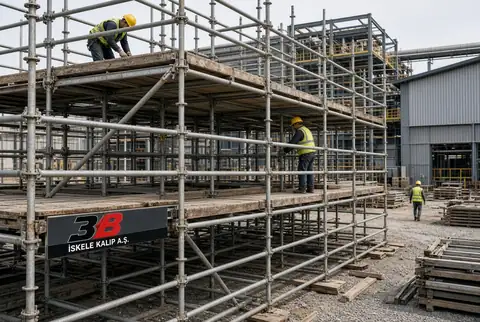
Cup-and-blade node. Falsework towers and regular grids from the same family. TS EN 12810 / 12811 compliant cuplock scaffolding; hire, sale and erection.
The values below are the language of standard cuplock (cup-and-blade) scaffolding. Exact stock and load class are confirmed in the quotation; falsework towers belong to the project structural calculation.
| Item | Value |
|---|---|
| Vertical member | Ø48.3 mm cup standard |
| Node | Bottom cup + rotating top cover (cuplock) |
| Ledger / diagonal | Blade-ended ledger and diagonal |
| Coating | TS 914 EN ISO 1461 hot-dip galvanizing |
| Standard | TS EN 12810 product, TS EN 12811 load and guardrails |
| Forms | Falsework tower, access grid, high leg |
| Load | Support and tower class; tied to the structural calculation |
| Lock | Cup cover + hammer |
Cuplock scaffolding is not a single vertical tube. Cup, blade, diagonal and platform are read as one set. Mixed stock ruins the node.
01
Backbone standard
02
Blade seat
03
Rotating lock
04
Blade-ended ledger
05
In-plane stiffness
06
Ground levelling
07
Load transfer
08
Walking surface
09
Working-lift edge
10
Stops material falling
11
Between lifts
12
First-lift spacing
Cuplock scaffolding systems are the backbone on a regular grid. On a straight insulation facade, H-type is faster; rings and inclined steel need ringlock.
Regular bays under slabs and decks. Nodes are read instead of a forest of props; deflection is locked in the calculation.
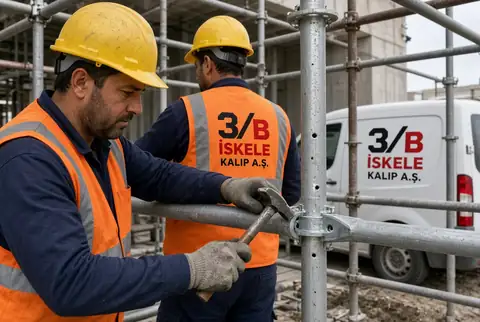
Repeating towers, diagonals and standard lifts. This is the backbone at heights a telescopic prop cannot cover.
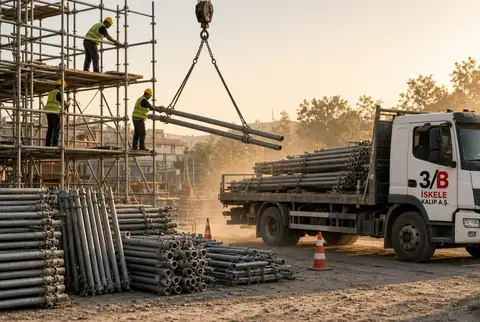
Maintenance and erection platforms on a straight grid. On rings and inclined steel, ringlock is freer.
Search intent is not “cheapest m²”. On a straight facade, H-type guarded facade scaffolding gains speed. On falsework and regular towers, cuplock is required.
| Case | Cuplock | H-type |
|---|---|---|
| Straight residential / office facade | Unnecessarily heavy | Correct backbone |
| Falsework, regular towers | Correct system | Not enough |
| Connection | Cup + blade | Frame + ledger + diagonal |
| Erection (straight facade) | Too much grid | Fast |
| Load class | Support and tower | Facade work |
Both are industrial class. Cuplock gains tempo on a regular grid. On angled equipment ringlock is freer.
| Case | Cuplock | Ringlock |
|---|---|---|
| Regular grid, falsework | Faster | Does the job |
| Angled and circular equipment | Will not fit | Correct system |
| Rings and brackets | Limited | Come off the rosette |
| High node load | Tied to the grid | Leads |
Installation depends on the project and pour programme. On falsework towers the striking sequence is written first.
What cuplock scaffolding is, how it differs from H-type and ringlock, how hire is priced — short answers.
It is a modular industrial system in which the ledger blade seats in the cup on the standard and the top cover turns to lock. It is not straight facade scaffolding. It gains tempo on falsework towers, slab support and regular grids.
TS EN 12810 is the product framework; TS EN 12811 is the load and guardrail rule. Galvanizing is read with TS 914 EN ISO 1461. Cups, blades and diagonals are not completed with undocumented mixed stock. A certificate does not replace site anchors.
On straight residential and office facades, H-type guarded facade scaffolding is sufficient and faster. Falsework, high legs and regular tower grids need cuplock. On mixed sites both can be used together.
On a regular grid, slabs and falsework, cuplock gains speed. On angled geometry, circular equipment, brackets and high node loads, ringlock is freer. The decision follows the form on survey, not the stock.
Hire is usually m² / month; falsework applications are a separate band. Number of lifts, tower height, duration and haulage shift the unit. Reference ranges are on the price page; the firm figure comes after survey and the structural note.
Yes. Supply, structural notes and erection-dismantling are planned under the same roof. Pouring calendars and tower striking sequence are written from the start. Dispatch is from stock in İzmir Torbalı, İstanbul Tuzla / Orhanlı and Kosova Ferizaj.
Scaffolding and Formwork Systems Guide for Infrastructure, Bridge and Viaduct Projects
Read article
Ringlock Scaffolding Advantages
Read article
Ringlock Scaffolding in Industrial Plants: A Guide to Maintenance, Erection and Occupational Safety
Read article
What Are TS EN 12810 and TS EN 12811?
Read article
Scaffold Hire or Purchase?
Read article
Safe Scaffolding Erection Guide
Read article
Reach the 3B İskele team for survey, rental, sales and erection. Don’t close quantities by guesswork — we’ll pin down the right system together. Use 3biskele.com or WhatsApp for a quote.
Izmir Head Office · Torbalı / Izmir
Istanbul Factory & Warehouse · Tuzla / Orhanlı
Kosovo Warehouse · Ferizaj