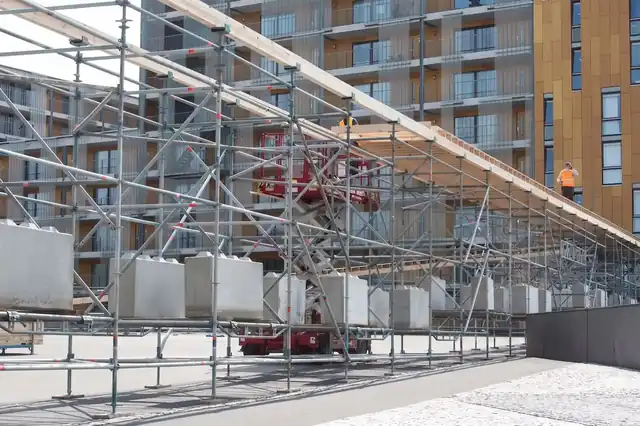
Safe scaffolding erection is not “stacking the steel” on site; it is tying ground, load class, anchors and guardrails into the same sequence. Without a survey, quantity breaks. Without an erection plan, guardrails are left to the top lift. TS EN 12810 describes the facade system; TS EN 12811 describes the load and guardrail rules of temporary works equipment. This guide tells safe scaffolding erection in site sequence.
The right sequence holds three promises: the worker does not fall, the pedestrian is not harmed, the programme does not stop because of the tower. The wrong sequence comes back as an invoice: loose pins, anchors stripped too early and a platform filled like a store.
What is safe scaffolding erection?
Safe scaffolding erection is the job of a written survey, an erection plan tied to the structural note, a guarded rise lift by lift, and periodic inspection. The system may be H-type guarded facade scaffolding, a ringlock tower or a mobile tower. The erection language does not change: height does not increase until the base sits.
On guarded facade scaffolding the guardrail is part of the system. The “we’ll fit it later” approach produces unprotected circulation at every lift. On ringlock work the rosette and diagonal lock are the name of the same discipline. A mobile tower’s wheel lock and outrigger are also part of erection; they are not skipped even indoors.
3B İskele keeps this work under the same roof as supply and site erection–dismantling. Because undocumented fast assembly is not safe scaffolding erection.
Before erection: survey and documents
A tower locked in without seeing the site produces missing parts or extra labour on day one. On the survey, building levels, ground, power lines, the neighbouring plot, the pedestrian pavement, crane swing and the material stacking area are read in place. A “standard package” is not dispatched without photos, height and a programme.
Documents are three pieces. The product certificate defines the system. The structural note ties this site’s wind and anchors to the calculation. The erection–dismantling plan writes the sequence. TS EN 12810 / 12811 is the framework of those three. A PDF on the shelf does not carry a stripped guardrail.
Load class is also locked on the survey. Plaster-and-paint and a stone pallet are not the same platform limit. Safe scaffolding erection does not start by declaring the platform a store.
What do TS EN 12810 and TS EN 12811 bind in erection?
TS EN 12810 is the product and design framework of a prefabricated facade scaffolding system. H-type guarded facade scaffolding is read in this family. TS EN 12811 gives load class, guardrails, access and general design. During erection the two stand together.
The site questions are these. Which load class is the system? What is the anchor spacing? Is guardrail height sufficient? Is there a platform gap and a toeboard? Is the stair tower written down? If the answer is empty, even if assembly tempo wins it does not count as safe scaffolding erection.
The rule does not change on a hired set. Hire does not lower the safety class. Delivery count and labels are the first check of erection.
Safe scaffolding erection steps
If a step is skipped, the lift above magnifies the error. The steps below are the H-type facade spine; on ringlock and mobile work the same logic is adapted to the geometry.
1. Ground, base plate and jack
The ground may be fill, wet screed, oily concrete or grating. A base plate and timber sole board are considered for every leg. One leg that does not sit bends the tower invisibly.
Slope and thresholds are not passed with “it will do”. If the level is lost at the base, every frame carries the deviation. The first lock of safe scaffolding erection is the ground.
2. First frame, brace and levelling
The first lift is not rushed up. The second lift is not opened until braces, pins and nodes are locked. On H-type the frame rhythm, on ringlock the rosette–wedge lock, is the language of this step.
Plumb is checked at every lift, not daily. The sentence “we’ll tidy it later” also breaks the anchors.
3. Platform, guardrail and toeboard
As soon as the platform is laid, guardrails and toeboards are fitted. The worker is not sent onto an unprotected lift. A safety harness does not cancel this step; the harness is also used on a platform that has guardrails.
Platform gaps and intermediate rails are the daily form of TS EN 12811. Stacking material overruns the load class. Safe scaffolding erection does not make the platform a mortar and pallet store.
4. Anchors
Anchors are connected early at the planned spacing. If facade insulation and stone details will later swallow the anchor hole, the insulation is discussed from the start. A late anchor is the name of a free tower in the wind.
Nets and sheeting increase the wind area. Uncalculated sheeting turns the tower into a sail. On an urban site a net is often required; sheeting is not always required.
5. Stair tower, upper lifts and handover
Vertical circulation is solved with a stair tower or a safe gate. A “we’ll climb out there” opening is the classic start of an accident. Upper lifts rise in the same order: frame, brace, platform, guardrail, anchor.
At handover there is a count, a load plate and the site supervisor’s signature. Safe scaffolding erection without handover is half a job.
| Step | Check | If skipped |
|---|---|---|
| Ground / base | Sole boards, plates, level | The tower leans |
| First lift | Brace, pin, plumb | Every lift drifts |
| Platform + guardrail | Toeboard, gaps, harness | Fall risk |
| Anchor | Spacing, type, facade detail | Free tower in the wind |
| Stair tower | Gate, descent, number | Climbing the braces |
| Handover | Count, plate, signature | An ownerless system |
In use: daily inspection
When erection finishes the job does not. The second half of safe scaffolding erection is a visual check before every shift. After rain and wind the list runs again.
Inspection list:
- Loose pins, wedges and braces
- Missing or stripped guardrails
- Shifted platforms and open gaps
- Removed or loose anchors
- Settled ground, shifted sole boards
- Torn nets, uncalculated sheeting
- Stair tower and gate
- Pallets and mortar heaps on the platform
A small deviation is caught before a large failure. The list is kept not for paperwork but for standstill and accidents.
Safe dismantling
Dismantling looks like the reverse of assembly; it is more hazardous. If anchors are removed early, the upper load crushes the lift below. Rushed dismantling grows both the accident and lost parts.
The dismantling plan is also written. Material lowering, pedestrian protection and truck sequence are not left to the last week. Just as safe scaffolding erection does not leave the guardrail to the end, dismantling does not strip the anchors from the top first.
Erection differences by system type
| System | Erection spine | Typical error |
|---|---|---|
| H-type guarded facade | Lift rhythm, anchors, stair tower | Leaving the guardrail to the end |
| Ringlock / cuplock | Rosette–wedge, diagonals, load class | Mixed stock, half wedges |
| Mobile tower | Wheel lock, outrigger, ground | Moving it with people on it |
Facade work is not solved with a mobile tower. Indoor paint also does not ask for H-type strip-and-rebuild every time. Safe scaffolding erection starts by choosing the right system.
PPE, harness and competent crew
Helmet, safety harness and work boots are mandatory. PPE does not legitimise an unguarded platform. A certified erection crew, permits and the H&S file are part of erection.
A wind stop threshold is written in advance. Upper-lift erection stops above a given speed. “Get the job finished” pressure looks for the first rule of safe scaffolding erection to sacrifice. Losing a day is cheaper than one serious accident.
Delivery: İzmir, İstanbul, Kosova
Erection stops with missing diagonals and late guardrails. 3B İskele ties the survey and erection plan from the İzmir Torbalı head office. The İstanbul Tuzla factory and Orhanlı warehouse line issue a marked set on Marmara dispatch.
The Kosova (Ferizaj) warehouse carries the same erection language on Balkan sites. Spare wedges, platforms and palletised stacks are the logistics insurance of safe scaffolding erection.
Clarify before you go to site: height, ground, load class, anchors, stair tower, dismantling date. If this list is missing, assembly is tempo, not safety.
Common mistakes
- Locking quantity without a survey
- Leaving the guardrail to the top lift
- Postponing the anchors
- Using the platform as a store
- Accepting undocumented hire
- Leaving dismantling to the most tired shift
- Substituting a harness for a guardrail
These errors grow with the excuse of a “small job”. Safe scaffolding erection wants the same sequence on light work too.
Conclusion
Safe scaffolding erection is ground, level, guardrails at every lift, early anchors, a stair tower and daily inspection. TS EN 12810 and TS EN 12811 are the framework of this sequence. H-type, ringlock or mobile does not matter: if a step is skipped the system stops being scaffolding.
Do not close the quantity on the phone. Ask for a survey, an erection plan and a site crew. 3B İskele runs supply and erection–dismantling in the same language.
A safe scaffolding erection quotation for your project is taken via 3biskele.com or the WhatsApp line. The İzmir Head Office, İstanbul Tuzla / Orhanlı factory–warehouse and Kosova (Ferizaj) warehouse teams reply in the same site language.