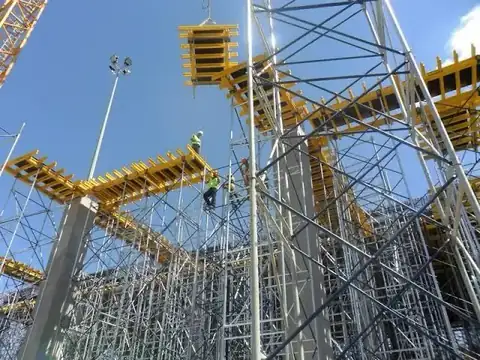
Housing and office slabs
On repeating floor slabs, table form gains speed. At changing levels and landings, telescopic props come in.
The supporting system under slab and deck formwork. The table is erected, the pour is taken, then it is moved to the next span. Hire, sale and erection.
Table form sizes depend on project slab thickness and fresh-concrete load. The framework below is for survey before quotation; net quantities are locked in the structural note.
| Item | Value |
|---|---|
| Use | Slab and deck falsework |
| Load path | Fresh concrete + formwork + live load; structural note |
| Transfer | Rolling or crane to the next span |
| Hire unit | m² / month |
| Site rule | TS EN 12811 load and safety framework |
| Package | Table + formwork face + striking plan |
| Stock | İzmir Torbalı, İstanbul Tuzla / Orhanlı, Kosova Ferizaj |
Table form is not a magic wand for every slab. It is the backbone on repeating plates and decks; if the geometry breaks, the system changes.
On repeating floor slabs, table form gains speed. At changing levels and landings, telescopic props come in.
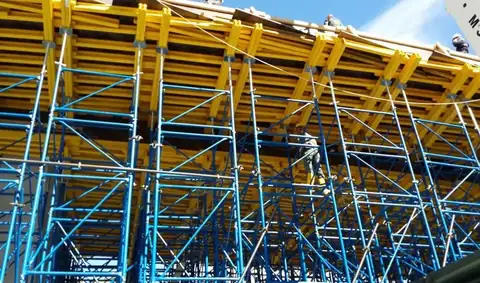
If the same span rhythm exists, the table is rolled. Inclined piers and broken sections need towers or special formwork.
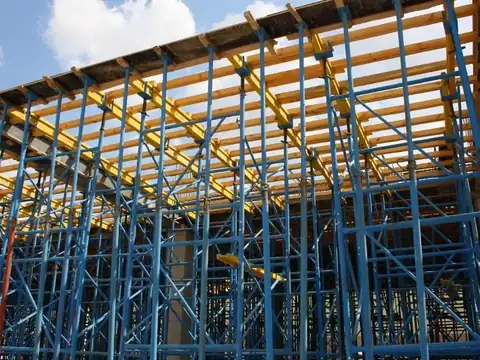
Face and vertical support are one package. If either is missing, deflection appears; early striking is forbidden.
Selection is not the cheapest m². Table form on repeating slabs; telescopic props on small, broken levels; cuplock or ringlock towers on high legs.
| Case | Right system |
|---|---|
| Repeating slab / deck | Table form |
| Small spans, changing levels | Telescopic prop |
| High legs, heavy load | Cuplock or ringlock tower |
| Narrow culverts, broken formwork face | Tower + special formwork |
What table form is, when it is chosen, how price is read — short answers.
Table form is a table + vertical support system carrying slab or deck formwork from below. The table is erected, concrete is poured, and after sufficient strength the table is rolled or crane-lifted to the next span. On repeating slabs it shortens labour time.
It is correct on housing slabs, office plates, and bridge and viaduct decks where the same grid is erected several times. On inclined piers, changing sections, narrow culverts or a broken formwork face, table form is not enough; telescopic props or towers are required.
Table form on repeating large slabs. Telescopic props on small spans, stair landings and changing levels. Cuplock or ringlock towers on high legs and heavy loads. All three can be used on the same site; selection follows geometry.
Hire is usually read as m² / month. Slab area, storey height, formwork load and duration shift the unit price. Reference ranges are on the price page; the firm figure comes after the structural note and survey.
Hire leads on a single site and project-based bridge-deck work. Contractors with continuous slab work take core stock and hire the peak. Erection-dismantling and the striking plan are discussed under the same roof.
Reach the 3B İskele team for survey, rental, sales and erection. Don’t close quantities by guesswork — we’ll pin down the right system together. Use 3biskele.com or WhatsApp for a quote.
Izmir Head Office · Torbalı / Izmir
Istanbul Factory & Warehouse · Tuzla / Orhanlı
Kosovo Warehouse · Ferizaj