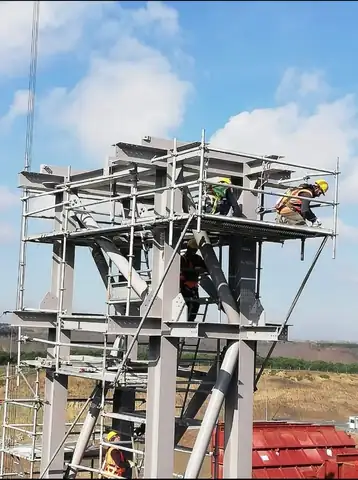
An industrial plant is a different world from a construction site. Boilers, columns, pipe bridges, conveyors, silos and reactors do not behave like a flat facade. Here scaffolding is not “wrapping the building”; it means weaving a safe working shell around the machine, the tank and the steelwork. Ringlock scaffolding systems exist precisely to build that shell.
Factory maintenance is often squeezed into a shutdown window. Three days, five days, perhaps fourteen. If scaffolding is late in that window, welding, insulation, NDT and painting crews wait. If it is taken down early, the job is left unfinished and the plant cannot return to production. That is why scaffolding choice in industry is not a procurement detail; it is part of the production plan.
Safe industrial access comes down to three headings: load-bearing capacity, geometric flexibility and controlled erection. If those three are not present at the same time, the system is either too weak or will not fit the site. Keep these three measures in mind when you decide.
Where is industrial scaffolding used?
Typical site scenarios are these: turnarounds on refinery and petrochemical units, boiler and turbine maintenance at power plants, silo and rotary-kiln work at cement and mining plants, hygienic-area overhauls in food and pharmaceutical plants, crane-rail and steel hangar maintenance in ports and heavy industry, tank and bridge work at treatment plants.
The shared feature of this work is asymmetric geometry. There is no flat wall. Pipe, flanges, valves, stair towers, cable trays and fire lines split the working area. Classic facade scaffolding either uses too much material in these gaps or does not sit at all. Ringlock fills the gap by taking members out in many directions from the node.
Why does ringlock stand out in industry?
The node of ringlock (rosette-type) systems is the rosette on the standard. Ledgers, diagonals and cantilever members connect from that rosette. The result is that different forms — towers, hanging platforms, circumferential rings, internal scaffolds and access bridges — are produced from the same material family.
Load capacity is high. Maintenance crews take not only themselves onto the platform but also welding sets, insulation bales, valves, flanges, tool chests and sometimes a temporary hoist leg. The painter’s load on facade work and the industrial maintenance load are not the same class. Quantities that miss this difference bend the platforms on day one.
Erection speed, when planned correctly, shortens the shutdown. Parts are standard, connections lock with a hammer, and the need for welded specials falls. Of course “fast” does not mean “unplanned”. In industry, unplanned speed is the most expensive slowness.
How do you separate cuplock and ringlock?
Cuplock is fast especially on regular grids and formwork support. The cup node produces a clean grid at set levels. It is very efficient on floors, stands, stages and some industrial platforms.
Ringlock is freer on angled geometry. A ring wrapping a boiler, a stepped tower around an inclined steel column, a walkway under a pipe bridge — ringlock comes to the front where cuplock does not sit comfortably. On many large turnarounds the two systems can also be used together. What matters is not “whatever stock we have, we’ll erect that”, but choosing the right family for the geometry.
Scaffolding in a live plant: the unseen risks
Shutdown maintenance is relatively controllable. The real difficulty is work done while production continues. A tower erected beside a conveyor can cut the forklift route. Welding sparks can drop onto a hydraulic unit on the floor below. A scaffold leg can block a fire hydrant. A platform can block the front of an emergency escape stair.
That is why an industrial scaffolding survey is not only “metres and height”. What must be looked at together with operations: hot-work permits, gas and dust class, ATEX zones, energy isolation, fire load, escape routes, crane and forklift corridors, night lighting, noise and clashes between simultaneous crews.
Hygienic plants add another layer. On food and pharmaceutical sites, dirty material, paint chips and rust flakes are not accepted. Scaffold members must be checked before they enter the area, and rubber bases and protective measures must be discussed. In industry the sentence “scaffolding was erected” is not enough; the sentence sought is “it was erected without disrupting the plant”.
Why are structural calculations and load classes not a bargaining item?
On industrial scaffolding, intuition is dangerous. The sentence “this much steel will carry it” is not a calculation. Cantilever projections, hanging scaffolds, tall towers and wind-catching platforms raise node forces quickly. Especially on ring scaffolds around boilers, inward leaning and sparse anchor points make a structural note mandatory.
Load class is live load, material load and wind read together. A welding crew’s single shift is not the same as a shift where the insulation crew stacks material. Load plates written on platforms also establish site discipline. Without a plate, everyone says “we’ll put a bit more on”.
That is why engineering support is not a decoration on the quote; it is the backbone of the job. Survey, 3D layout or at least a floor plan, anchor points and dismantling sequence must be written. Teams that know the site, such as 3B İskele, discuss this paperwork inside the quote, not after the sale. Because in industry an accident file does not close with “there was scaffolding”; it opens with “was the scaffolding erected correctly?”
Three non-negotiable rules of erection discipline
First rule: ground and bearing. Plant floors can be grating, voids under grating, oily concrete and sloping platforms. Base plates, timber sole plates or steel pads must be thought through for every leg. One leg that does not sit bends the tower in a way you cannot see.
Second rule: verticality and diagonals. Industrial geometry does not allow “leave it a bit out of plumb, we’ll tidy it later”. Every lift needs levelling, diagonal locks and node checks. Wedges only half-seated in rosettes open over time in a vibrating plant.
Third rule: guardrails and access. If there is a platform, there is a guardrail. If there is a gap, there is a toe board. If there is access, there is a stair or a safe walkway. An opening left as “we’ll climb out there” is the most expensive sentence in maintenance. On industrial scaffolding, a temporary fix produces a permanent risk.
Logistics that shorten the maintenance shutdown
As the shutdown window narrows, logistics become more critical than material quality. The wrong part, a missing diagonal, a late cantilever delays welding by a day. That is why the material list must match survey photographs, a spare node and wedge allowance must be left, and staged deliveries to site must be planned.
Storage is also part of the job. Scattered scaffolding in the plant yard both produces losses and causes forklift accidents. Palletised, labelled, layer-separated material visibly increases erection speed. The same discipline is required at dismantling. When the shutdown ends, everyone rushes. Rushed dismantling grows both accidents and lost parts.
The hire model is often preferred in industry. Turnarounds are periodic; stock can sit idle eleven months of the year. Purchase makes sense at plants with a continuous maintenance workshop and small jobs every month. There is also a hybrid model: core stock inside, reinforcement from outside on large shutdowns.
Common industrial mistakes
Tying anchors casually to plant steel. Blocking a fire line with a scaffold leg. Using the platform as a store. Forgetting covers and a fire watch before dropping welding fumes to the floor below. Working on an unlit tower on the night shift. Doing dismantling without a plan, as “as long as the material goes on the truck”.
None of these mistakes is born of bad intent. Tempo produces them. Tempo is only tamed with a written plan, a site supervisor and spare material. Industrial scaffolding work is not managed with the visual tempo of construction; it is managed with permits, isolation and shutdown hours.
How do you choose the right partner?
Do not measure a supplier only by stock size. Ask for industrial references: boilers, silos, pipe bridges, reactors, turbines. Is a survey done? Is a structural note produced? Is there night and weekend erection? Is a fault allowance left? Does the dismantling crew arrive with the same discipline?
When the answers become clear, the name also becomes clear. 3B İskele keeps ringlock and cuplock under the same roof and produces a solution for the plant’s geometry. It does not make you memorise a sales catalogue; it plans material and crew to the shutdown calendar. When you say “let’s erect scaffolding”, what you are actually looking for is this: on this unit, in this time, with this load, finish the job without an accident.
When logistics on the İzmir and İstanbul corridor, industrial stock and site engineering come together, the load on the maintenance manager’s shoulder falls. Trust, speed and calculation are not purchased separately in industry. All three must arrive together.
Preparation calendar before a turnaround
Four to six weeks before a large shutdown, survey photographs, the obstacle list on the unit and permit procedures must be collected. Three weeks out, the material list is locked and spare wedge–rosette and cantilever allowance is set aside. Two weeks out, palletised delivery and stacking plans run on site. One week out, the erection crew’s plant cards, training and PPE are completed. If the truck is waiting at the gate on the morning of the shutdown, day one is already burned.
This calendar is not exaggeration. In industry a scaffolding delay is a welding and insulation delay. Every delayed shift costs more than the hire difference. Ready stock, marked parts and a crew used to night shifts are the real meaning of “fast erection”. Speed is not rushing; it is arriving prepared.
If erection is beside a live line, the forklift corridor, fire hydrant and escape stair must be protected with red tape. Platform skirts stop falling objects. If production is on the floor below, every screw above is treated as a risk. That is why industrial scaffolding does not resemble a construction tower; it is embedded in the plant procedure.
Conclusion
Ringlock scaffolding is the safe working shell in the complex geometry of an industrial plant. It must not be confused with cuplock, nor used blindly in place of facade scaffolding. If load class, anchors, plant permits and shutdown logistics are locked from the start, maintenance finishes both short and safe.
Before the next turnaround, ask for a photographed survey, a material list and an erection calendar. In industry the cheapest scaffolding is the scaffolding that does not extend the shutdown by a day. 3B İskele builds that calculation in site language, because a plant rises not from a catalogue but from the right node.