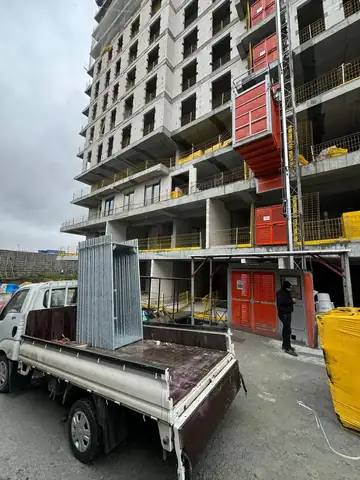
The answer to scaffold hire or purchase is not in the daily rate; it is in the duration of the job. On a one-off or 3–8 month site, hire leaves storage, maintenance and wastage with the supplier. On housing, formwork or plant maintenance that repeats every year, core stock is purchased. Peak demand is still hired.
The decision becomes clear with three questions: how many months will the scaffold stay on site, will this stock return to the same work next year, and is the warehouse your line? A model locked in before those three are written either ties up cash or inflates hire.
Direct answer: which model, which job?
Hire on short, closed-ended work. A housing facade, a single estate, a shopping-mall refurbishment, a single bridge, a single plant shutdown sit in this group. Material arrives, the job ends, the tower comes out.
Purchase on repeating work, but not all of it. A painting–plastering contractor, a continuous housing producer, a formwork contractor and a plant-maintenance crew hold core stock. High-rise, special cantilevers and shutdown reinforcement are closed with hire.
Buy-back is the third path. Purchased material returns at an agreed value at the end of the project. For a firm that does not want to fill a warehouse or lock capital in steel, that is the balance.
When does hire hold?
Hire is an advantage where the dismantle date stands in the work programme. Facade work depends on the shell, the windows and the thermal cladding. If that chain is locked, the hire line is foreseeable.
The invisible part of the advantage is operations. Winter storage, paint, bent frames and lost pins do not become your balance sheet. Haulage and erection–dismantle are separate items; they are still lower than the annual cost of idle stock.
The weak point is duration extension. If the quote has no extra-day unit, wastage rate or missing-part charge, “cheap hire” turns expensive in the second month. Write the programme against shell construction and dismantle.
When does purchase hold?
Purchase holds at a firm whose stock goes to site several times in a year. An H-type or mobile tower standing in the yard is plant, not hire. The second and third sites pay the depreciation.
The limit is this: buying everything consumes warehouse and cash. Take core stock. Hire the peak. TS EN 12810 / 12811 remains your obligation after hire ends; bent frames and mixed stock are rejected in the second year.
If there is no warehouse, purchase produces hidden hire. Space, forklift, counting and rust are the hire cost of idle steel.
Hidden-cost comparison
m² / month or unit / month alone does not decide. The lines below are what actually make a model cheap or expensive.
| Item | Hire | Purchase |
|---|---|---|
| Warehouse and counting | With the supplier | Your space, forklift, labour |
| Maintenance | With the supplier | Paint, wedges, spare parts |
| Wastage / loss | The share in the contract | Missing pins, guardrails, diagonals |
| Haulage | Delivery + return | Your logistics between sites |
| Duration extension | Extra day / extra month | Stock locked on site |
| Cash | Operating expense | Capital tied up |
| Documents | Come with the set; check them | The file stays with you |
The facade-hire reference on most jobs runs as m² / month. Ring-lock systems rise with load class. Mobile towers are calculated per unit / month. A round “send one tower” order produces either insufficient height or excess hire.
Hybrid model and buy-back
A healthy decision is most often not hire or sale. Core stock is purchased. Peak season and special geometry are hired. Cash and tempo are protected together.
On buy-back, value, material condition and counting method are written in the contract from the start. “We’ll look when the job ends” erases buy-back. 3B İskele discusses production, hire and buy-back in the same quote after the survey. The aim is not stock pride, but to empty the site on time.
Preference by system type
H-type guarded facade scaffolding
On a single housing or estate facade, 3–8 months of hire is common. At a firm that finishes several blocks every year, a core H-type + peak-hire hybrid is held. If thermal cladding overruns, the inflated hire is a programme error, not a system error.
Ring-lock and cuplock
A plant shutdown is seasonal. Ring-lock stock sitting empty for eleven months of the year argues for hire. If a maintenance workshop produces work every month, core industrial stock is purchased; reinforcement is hired on a major overhaul.
Mobile scaffolding
Day-to-week refurbishment and a single shopping-mall job are hire. A plant crew and a continuous painter buy the tower. Extra units are still hired in peak season.
Formwork, table forms, telescopic props
A single viaduct or culvert is a hire job. On continuous infrastructure contracting, core formwork stock is purchased. Formwork face and support are the same package; if one is missing, deflection appears.
| Job type | Typical duration | Common preference |
|---|---|---|
| Single housing / estate facade | 3–8 months | Hire |
| Housing that repeats every year | Continuous | Purchase + hire top-up |
| Single plant shutdown | 1–4 weeks | Hire |
| Plant maintenance workshop | Year-round | Purchase + hire top-up |
| Shopping-mall / hotel refurbishment | Day–week | Hire |
| Single bridge / culvert | Project duration | Hire |
| Continuous infrastructure contractor | Year-round | Purchase + hire top-up |
Standards are required on a hired set too
A hire contract does not cancel the guardrail. TS EN 12810 describes the performance framework of a facade system; TS EN 12811 describes the safety approach of temporary works equipment. Material certificates, an erection plan and periodic inspection are also on the table for a hired set.
Count on delivery, the same count on dismantle. Bent frames and missing diagonals are your risk on site. If erection–dismantle is not written into the quote, the safety advantage of hire is zeroed.
Delivery: İzmir, İstanbul, Kosova
The practical advantage of hire is stock at the door. The wrong height is a waiting-crew invoice. 3B İskele locks survey and quote from the İzmir Torbalı head office. The İstanbul Tuzla factory and Orhanlı warehouse line speed Marmara shipments.
The Kosova (Ferizaj) warehouse carries the same hire–sale language on Balkan hotel–mall and plant work. When the model is chosen, haulage distance, a spare-parts allowance and the dismantle date must stand together.
Lock this list before you decide
- Duration: how many days / months will the scaffold stay on site, is the dismantle date clear?
- Repeat: will this stock return to the same type of work next year?
- Warehouse: where will empty material land, who holds the count?
- System: H-type, ring-lock, mobile or falsework?
- Erection: who owns erection–dismantle, whose file is H&S?
- Extension: is the extra-day unit price written in the quote?
- Documents: do TS EN 12810 / 12811 and material certificates come with the set?
- Exit: on purchase, is there a buy-back value and condition?
If these items are empty, the “hire or purchase” discussion stays a catalogue sentence.
Common mistakes
- Deciding on a daily or m² price
- Not writing duration extension into the quote
- Buying the whole stock when there is no warehouse
- Accepting undocumented hire
- Leaving wastage and loss clauses for later
- Treating purchase as prestige and hire as weakness
The wrong model costs tempo and cash. The right model empties the site and the balance sheet together when the job ends.
Conclusion
Hire on a single, short job. On repeating work take core stock and complete the peak with hire. Buy-back is the exit of purchase. TS EN 12810 / 12811 apply on both models.
Do not round the quantity. Write duration, warehouse and the work programme. 3B İskele clarifies hire, sale and buy-back after the survey.
Ask for the model that fits your project via 3biskele.com or WhatsApp. The İzmir Head Office, İstanbul Tuzla / Orhanlı factory–warehouse and Kosova (Ferizaj) warehouse teams reply in the same site language.