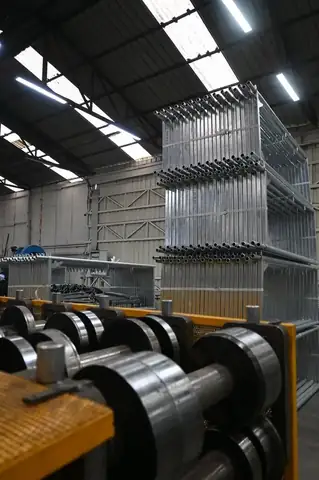
TS EN 12810 and TS EN 12811 are the TSE adoptions of two fundamental European standards for scaffolding safety. TS EN 12810 describes the product and design framework for prefabricated facade scaffolding systems. TS EN 12811 gives load class, guardrails and the general design rules for temporary works equipment. The document is valuable not because it sits on a shelf, but because anchors, platforms and erection follow these rules.
The sentence “compliant with the standards” is not a quote on its own. What load class is the system, what is the anchor spacing, is there a guardrail on every floor? If those questions are empty, the document is remembered in the accident file.
What is TS EN 12810?
TS EN 12810 belongs to facade scaffolding systems with prefabricated components. H-type guarded facade scaffolding is this family’s on-site counterpart. The standard frames how the system is named, what performance it promises and by which method structural design is done.
It is read in two main parts. TS EN 12810-1 is the product specification: components, marking, information for use. TS EN 12810-2 is the structural design methods. The “12810 system” claim on a purchase list is those two parts being tied to the erection plan on site.
Facade scaffolding rises storey by storey on a flat wall. Anchors, stair towers, platform width and fall protection are part of the system. 12810 defines that package. On vessels, silos and asymmetric steel, a ring-lock system comes in; there 12811 and the related design note come to the front, and 12810 is not imposed blindly.
What is TS EN 12811?
TS EN 12811 is the general safety and performance standard of the temporary-works-equipment family. It is not locked only to facades. Scaffold platforms, load, access, guardrails, material information and load testing sit under this roof.
The parts split the work. TS EN 12811-1 gives performance and general design. TS EN 12811-2 goes to material information. TS EN 12811-3 describes load testing. TS EN 12811-4 covers scaffold protection fans.
Site language becomes clear here. Platform class, guardrail height, toeboards and stair access are the daily counterpart of 12811. An opening left as “we’ll get out that way” is the first breach of the standard.
What is the difference between the two?
One defines the system; the other sets the rule for the work equipment. On a facade site they stand together. A “facade system” claim without 12810 falls as empty as a guardrail argument without 12811.
| Heading | TS EN 12810 | TS EN 12811 |
|---|---|---|
| Subject | Prefabricated facade scaffolding system | Temporary works equipment / scaffolding in general |
| Focus | Product, performance, system design | Load, guardrails, access, materials, testing |
| Typical site | H-type guarded facade | Facade + industrial platform rules |
| Enough on its own? | No; site rules are read with 12811 | No; the facade system is defined with 12810 |
| On a hired set | System certificate | Load class and guardrail discipline |
On mobile access towers the primary product standard is TS EN 1004. Instructions for use are read with TS EN 1298. Platform and guardrail discipline are still not thought of as detached from 12811. Falsework support is a separate family; it shifts onto the EN 12812 line.
What do load classes change on site?
TS EN 12811-1 classifies the uniformly distributed service load of the platform. Class is not a feeling that “this tower looks heavy”; it is a written limit. When the limit is exceeded, first deflection, then the connection, then a fall.
| Load class | Distributed load (approx.) | Typical work |
|---|---|---|
| 1 | 0.75 kN/m² | Inspection, very light access |
| 2 | 1.50 kN/m² | Painting, cleaning, light maintenance |
| 3 | 2.00 kN/m² | General facade work, render |
| 4 | 3.00 kN/m² | Masonry, heavier materials |
| 5 | 4.50 kN/m² | Heavy masonry, stacked pallets |
| 6 | 6.00 kN/m² | Very heavy work / dense materials |
Render and paint are not the same class as a stone crew’s pallet. The platform is not a store. When a mortar tub, stone and composite panels accumulate, class 3 work becomes a class 5 load. On a tower with no load plate, everyone says “we’ll put a bit more”.
Which questions does the standard answer on site?
The document is useless if this list is empty:
- What load and width class is the system?
- Are anchor spacing and type written down?
- Are guardrail height and intermediate rails present on every floor?
- Do toeboards and platform gaps follow the rule?
- Is there a stair tower or safe access?
- Is the erection and dismantle sequence written?
- Is there a wind, netting and banner calculation?
The guardrail is not the last ornament of the job; it is part of every floor. If anchorage is delayed, the facade system is left free against the wind. If plumb is lost, every floor magnifies the error. The on-site form of 12810/12811 is that sequence.
The same rule applies to a hired set
A hire contract does not cancel the standard. TS EN 12810 and TS EN 12811 speak the same language on hired H-type, on a ring-lock platform and on maintained stock. An undocumented cheap tower undermines the hire with accident and downtime invoices.
Count on delivery, the same count on dismantle. Bent frames, cracked wedges and mixed stock are not legitimised by “it’s hired”. In 3B İskele supply, the standard is not a sales sentence but part of the survey and the erection plan.
Document, static note and erection plan
The product certificate says in which class the system was manufactured. The static note ties this site’s height, wind and anchors to the calculation. The erection plan writes the sequence. If the three stand apart, the standard is left half-done.
On special cantilevers, tall free-standing towers and circular scaffolding, intuition is forbidden. The sentence “this much steel will carry it” is not TS EN 12811-1. If the calculation is unsigned, load class is a catalogue ornament.
Delivery and traceable stock: İzmir, İstanbul, Kosova
The standard ends where stock is mixed. The wrong wedge and an undocumented welded special part are rejected in the middle of a shutdown. 3B İskele locks survey and document language from the İzmir Torbalı head office. The İstanbul Tuzla factory and Orhanlı warehouse line issue a traceable set on Marmara shipments.
The Kosova (Ferizaj) warehouse carries the same TS EN framework on Balkan projects. The tender and operations file want documents; the site wants anchors and guardrails. Both must arrive on the same truck.
Common mistakes
- Saying “compliant with the standards” and not asking the load class
- Leaving the guardrail to the last floor
- Using the platform as a materials store
- Putting anchors off with “we’ll do it later”
- Not asking for documents on a hired set
- Imposing 12810 on ring-lock vessel work while ignoring 12811
None of these mistakes is only a paperwork gap. When tempo beats the written plan, the standard stays on paper.
Conclusion
TS EN 12810 defines the facade scaffolding system. TS EN 12811 sets the load and safety rules of temporary works equipment. They are read together and appear on site as anchors, guardrails and load class. Hire or sale makes no difference.
Ask for the document, the static note and the erection plan in the quote. 3B İskele supplies and applies H-type, ring-lock and related systems within this framework.
For your project’s load class and system choice, reach us via 3biskele.com or WhatsApp. The İzmir Head Office, İstanbul Tuzla / Orhanlı factory–warehouse and Kosova (Ferizaj) warehouse teams reply in the same standard language.